
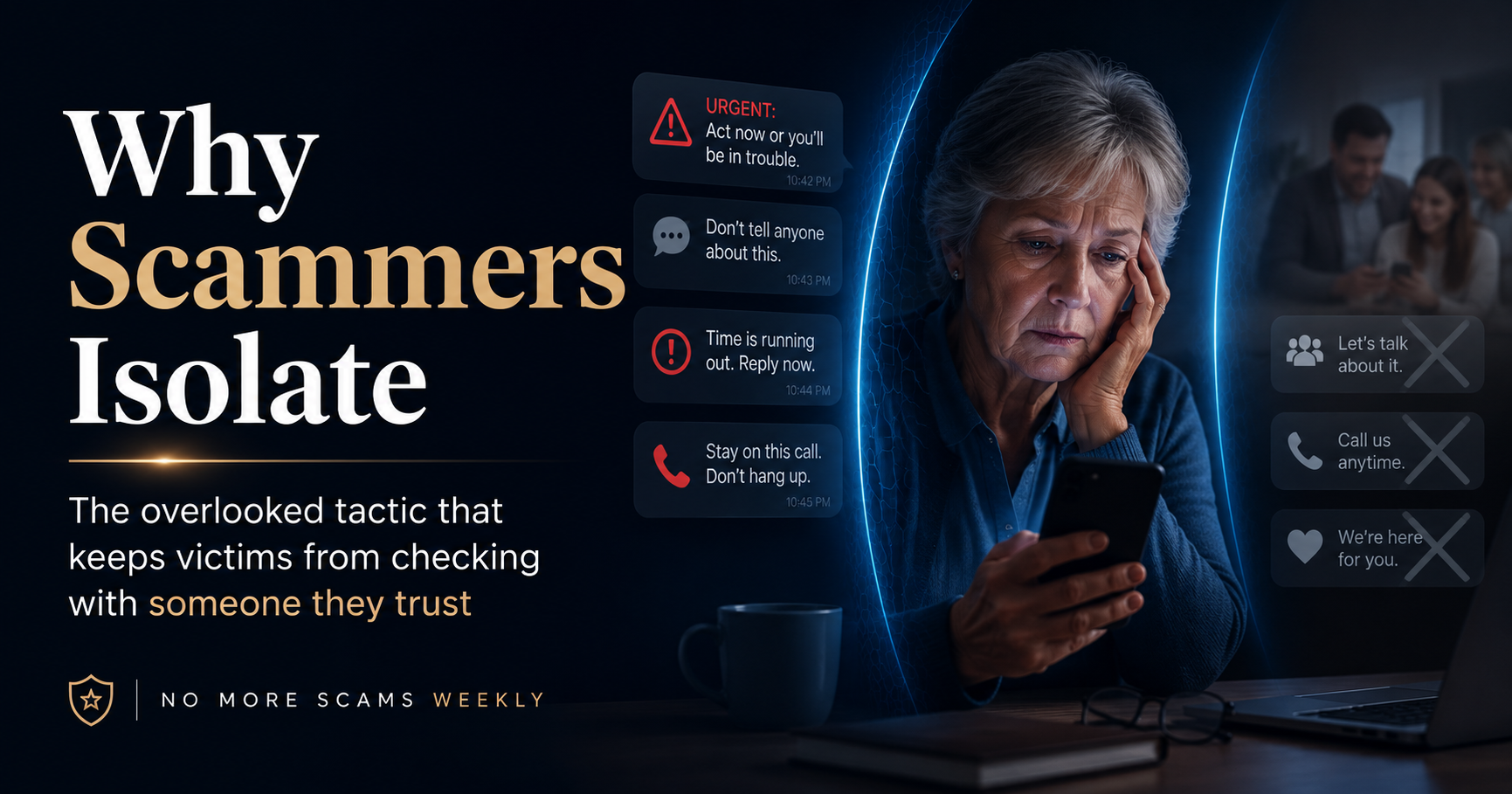
A scammer doesn’t always begin by asking for money.
Sometimes the more important move comes first.
They try to get you alone.
Not necessarily physically alone. They want you making the decision without the calm voice of a spouse, friend, adult child, bank employee, coworker, or someone else you trust.
You may hear:
“Don’t tell anyone about this yet.”
“Stay on the line with me.”
“This investigation is confidential.”
“Your family member will be embarrassed if anyone finds out.”
“Don’t call the bank—they may be involved.”
“You need to handle this immediately before things get worse.”
At first, those instructions may sound like part of the situation.
They may even sound responsible.
But there’s an important question worth asking:
Why would someone who claims to be helping you also want to control who you speak with?
That question reveals one of the most overlooked scam warning signs: isolation.
Scammers know that another person can interrupt the pressure.
A trusted friend might ask the one question you haven’t thought of.
A bank employee might tell you the transfer request makes no sense.
A family member might confirm that the supposed emergency never happened.
A spouse might simply say, “Hang up. We’ll check this ourselves.”
That outside voice can destroy the scammer’s advantage.
So the scammer may try to remove it before you realize you need it.
Isolation Doesn’t Always Sound Like “Keep This Secret”
The easiest isolation tactic to recognize is a direct secrecy request.
“Don’t tell anybody.”
That should get your attention.
But experienced scammers may package the same instruction in language that sounds more reasonable.
It may sound like privacy
“This is a confidential financial matter.”
It may sound like protection
“Don’t tell your family because we don’t want to frighten them.”
It may sound like procedure
“You must remain on the line while we secure the account.”
It may sound like law enforcement
“You can’t discuss an active investigation.”
It may sound like compassion
“Your grandson begged us not to tell his parents.”
It may sound like urgency
“There isn’t time to call anyone else.”
The words change.
The result is the same:
You are being separated from independent advice.
That distinction matters because most people don’t think, “This person is isolating me.”
They think:
- “I’m following instructions.”
- “I’m protecting someone.”
- “I’m handling this privately.”
- “I’m doing what the bank told me.”
That is exactly why the tactic can work.
Why a Second Person Is So Dangerous to a Scammer
A scam usually depends on maintaining a particular version of reality long enough to get you to act.
The caller says your account has been compromised.
The message says your package is being held.
The stranger says a loved one is in trouble.
The supposed government agent says you owe money.
The person says an opportunity will disappear if you wait.
While you remain inside that conversation, the scammer controls much of the information you’re receiving.
They tell you:
- What happened
- Why it happened
- Why it matters
- Why you must act
- What you must do next
- Who you should trust
- Who you should avoid
Then another person enters the picture.
Suddenly, the scammer no longer controls everything.
Your daughter might ask:
“Why would the bank tell you to transfer money somewhere else?”
Your friend might ask:
“If this is really the IRS, why can’t we call them back through an official number?”
Your spouse might say:
“Let’s call him directly and make sure he’s actually in trouble.”
Those aren’t advanced cybersecurity questions.
They are ordinary questions asked by someone who isn’t emotionally trapped inside the situation.
That can be enough.
The Calm-Person Advantage
When you’re frightened, excited, embarrassed, or worried about someone you love, it can be difficult to evaluate every detail clearly.
That doesn’t mean you’re careless.
It means you’re human.
The person outside the interaction has an advantage:
They aren’t experiencing the same pressure.
They haven’t been listening to the threatening caller for twenty minutes.
They haven’t been told that a loved one could be in danger.
They haven’t been warned that an account is supposedly being emptied.
They haven’t been promised a reward they’re about to lose.
They can look at the situation from the outside.
That is one reason a simple family rule can be surprisingly powerful:
No urgent financial decision stays private.
If someone asks for money, account access, gift cards, cryptocurrency, a security code, remote computer access, or sensitive personal information—and they also discourage you from speaking with someone you trust—that combination deserves an immediate pause.
You do not have to prove it’s a scam first.
You simply have enough reason to stop.
Keep the free Scam-Smart Checklist nearby when an urgent request tries to separate you from someone you trust.
Get the free Scam-Smart Checklist →Secrecy and Urgency Are Especially Dangerous Together
Secrecy becomes more concerning when it appears alongside urgency.
Consider the difference between these two messages:
Message A
“Please review this account issue when you have a chance. If you have concerns, contact us through the number on your card.”
Message B
“Your account is being drained right now. Stay on the line. Do not contact your branch because someone there may be involved. We need to move your money immediately.”
The second message creates a closed environment.
You are told there is danger.
You are told there is no time.
You are told not to contact another trusted source.
And the same person creating the fear is offering the solution.
That combination should change how you respond.
Not because it automatically proves fraud.
Because it makes independent verification more important.
The “Stay on the Line” Trap
One phrase deserves special attention:
“Stay on the line.”
There may be legitimate situations where a company asks you to remain connected briefly.
The concern begins when staying connected prevents you from verifying the claim independently.
If the caller insists that you:
- Remain on the phone while transferring money
- Stay connected while driving to a store
- Keep them on speaker while speaking with a bank employee
- Avoid answering another incoming call
- Refuse to contact family
- Continue following instructions without interruption
then the call itself may be functioning as a form of control.
You are not getting a chance to think without their voice in your ear.
The solution is simple:
End the call.
If the situation is legitimate, you can verify it independently and deal with it.
If the situation is fraudulent, ending the call removes the scammer’s ability to direct your next move.
Embarrassment Can Become Isolation Too
Not every scammer has to explicitly tell someone to keep quiet.
Sometimes embarrassment does the work for them.
A person may think:
- “I should have known better.”
- “I don’t want my kids thinking I can’t handle my finances.”
- “I’m embarrassed that I responded.”
- “I don’t want anyone to know I sent money.”
That silence can give a scam more time to continue.
If you clicked a suspicious link, shared information, sent money, gave someone remote access, or simply feel unsure about what happened, involving another person is often more useful than hiding it.
The goal is not blame.
The goal is getting another set of eyes on the situation.
A scammer benefits from embarrassment.
You benefit from information.
Family-Emergency Scams Depend on Emotion
Family-emergency scams show why isolation matters so much.
Imagine receiving a call from someone claiming to be your grandson.
There has been an accident.
He sounds frightened.
He says he’s in trouble.
Then comes the request:
“Please don’t tell Mom and Dad.”
That one sentence can change the entire situation.
Now you aren’t simply deciding whether the emergency is real.
You feel responsible for protecting someone you love.
Calling another family member can feel like breaking a confidence.
But that is exactly when independent verification matters.
A family rule established before an emergency can make the decision easier:
No secret emergency money requests. Ever.
If a family member truly needs help, verification does not make you uncaring.
It makes you careful.
Create a Family Verification Circle
You do not need a complicated family cybersecurity plan.
You need a few people and a few rules agreed upon in advance.
A simple verification circle might include:
- Your spouse or partner
- One adult child
- One sibling
- A trusted friend
- Another person who knows your family well
The point is not to call everyone.
The point is to make sure you are never forced to make a high-pressure financial decision completely alone.
A useful family agreement might be:
If an unexpected request involves money, personal information, account access, or secrecy, we contact at least one trusted person before acting.
That rule works because it is decided when everyone is calm.
You are not trying to invent a safety plan while someone is shouting that you have five minutes to save your bank account.
Use a Family Safe Word Carefully
A family safe word can add another verification step during an emergency.
Choose something your family can remember but that is not easily discovered from public information.
Avoid obvious choices such as:
- Pet names posted publicly
- Birthplaces
- Favorite sports teams
- Family nicknames used on social media
- Children’s names
- Anniversary dates
And do not rely on the safe word as your only protection.
If someone correctly gives the word but the situation still seems suspicious, independently contact the family member anyway.
The safe word is a tool.
It is not proof that overrides every other warning sign.
The Channel-Switch Test
Another useful technique is to change communication channels.
Suppose someone messages you claiming to be your daughter and asks for money.
Do not continue verifying through that same message thread.
Call her using the number already saved in your phone.
If someone calls claiming to represent your bank, end the call and contact the bank using the number on your card.
If an email claims an account is locked, open the company’s official app instead of using the email link.
This is important because the person making the claim should not also control the verification process.
Think of it as a simple rule:
Claim here. Verify somewhere else.
A Quick Isolation Check
When an unexpected request creates pressure, ask these questions:
Am I being told not to talk to someone?
That can include family members, friends, bank employees, police, coworkers, or another trusted person.
Am I being told I cannot end the conversation?
Pressure to remain connected deserves attention.
Is embarrassment keeping me silent?
If so, involve someone anyway.
Does the person object to independent verification?
A legitimate situation should not depend on preventing you from checking it.
Is secrecy combined with money or account access?
Treat that combination seriously.
Is the same person creating the emergency and supplying the solution?
Break the loop and verify elsewhere.
You don’t need every warning sign before acting.
Sometimes one unusual instruction is enough reason to slow down.
STOP • CHECK • VERIFY
The simplest response is still the strongest.
STOP
- Don’t send money.
- Don’t share a verification code.
- Don’t install software.
- Don’t provide personal information.
- Don’t continue because someone says you have no choice.
CHECK
Ask what is happening around the request.
- Are you frightened?
- Are you being rushed?
- Are you being told to keep quiet?
- Are you being discouraged from contacting someone else?
VERIFY
- Leave the conversation.
- Use a contact method you already trust.
- Talk with another person.
- Confirm the situation independently.
The scammer wants the decision made inside the pressure.
You want the decision made outside it.
You Are Allowed to Break Their Rules
A scammer may give you very specific instructions.
- Don’t hang up.
- Don’t tell anyone.
- Don’t call the bank.
- Don’t speak to your family.
- Don’t wait.
- Don’t ask questions.
Remember something important:
You did not agree to those rules.
You are allowed to hang up.
You are allowed to tell someone.
You are allowed to verify.
You are allowed to take ten minutes.
You are allowed to refuse.
And you do not owe an unexpected caller an explanation for protecting yourself.
Why Scammers Isolate
The reason is not mysterious.
Other people create friction.
- They slow decisions.
- They ask questions.
- They notice contradictions.
- They reduce emotional pressure.
- They provide another path to verification.
In other words, they threaten the scammer’s control.
That is why secrecy, isolation, and instructions not to seek outside help deserve far more attention than they usually receive.
Most people are trained to watch for the final request.
Watch for the isolation that comes first.
The next time an unexpected caller, message, or email tells you that something is urgent and that you shouldn’t involve anyone else, treat that combination as your signal to do exactly the opposite.
End the interaction.
Contact someone you trust.
Verify through a separate source.
You don’t need to solve every detail while the pressure is happening.
You only need to take back control of the decision.
STOP. CHECK. VERIFY.
Because when someone wants your money, information, or access—and also wants you isolated—the person they most don’t want you talking to may be exactly the person you should call.