
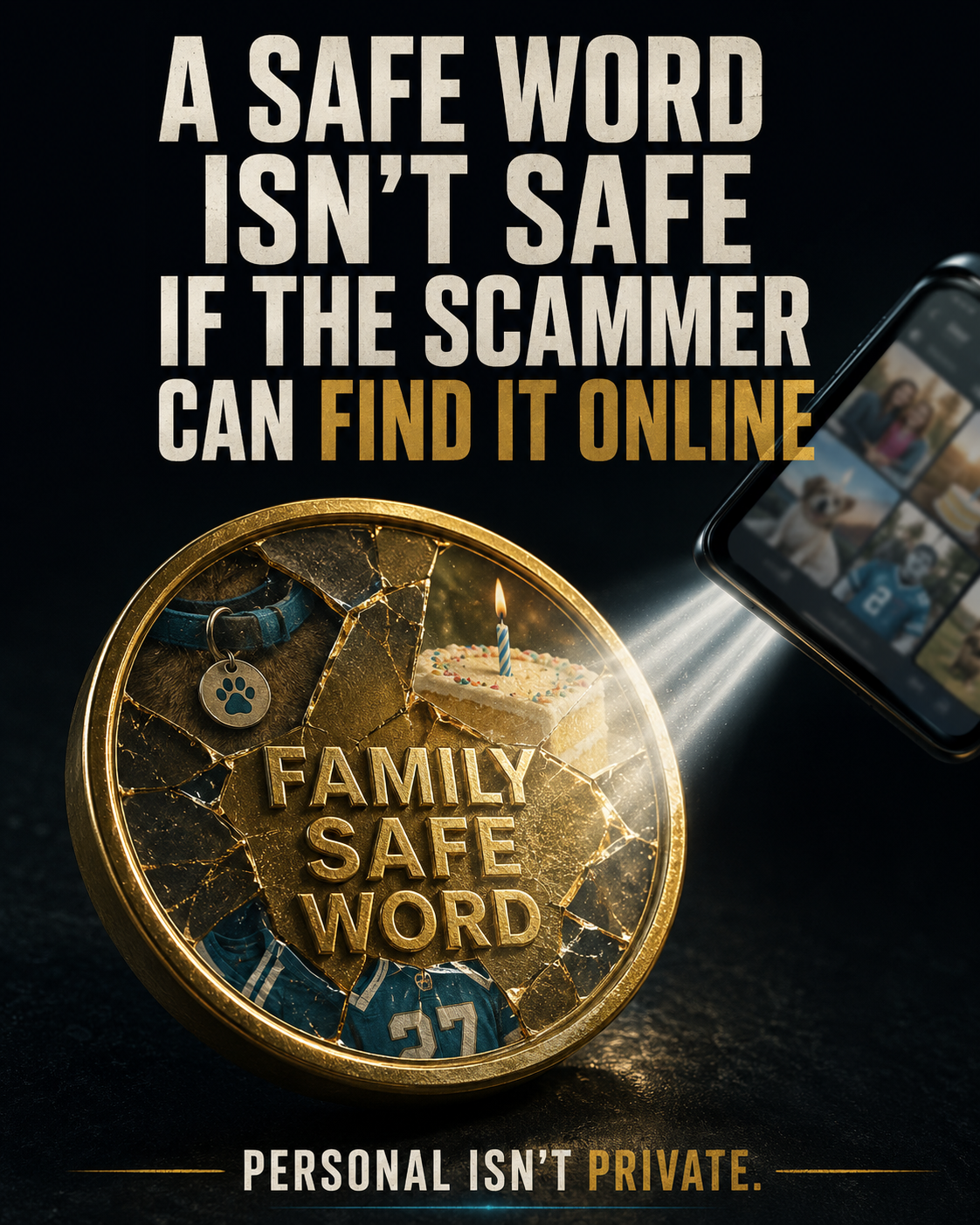
Most families choose safe words the same way they choose passwords they don’t want to forget. They reach for something familiar: a pet’s name, a grandchild’s school, a favorite sports team, a hometown, a birthday, or the make of a beloved car.
That feels sensible because everyone in the family already knows it.
It’s also the problem.
A detail can be personal without being private. Your dog’s name may feel like family knowledge, but it might appear in years of Facebook posts. Your favorite team may be printed on your shirt in dozens of photos. A grandchild’s school could be mentioned in a graduation announcement. A hometown, birthday, anniversary, nickname, or family vacation spot may be scattered across public profiles, online directories, old posts, memorial notices, and comment threads.
The central mistake is confusing recognition with secrecy.
If a word is memorable because it describes your real life, an impersonator may be able to learn or guess it. A useful family verification phrase should be memorable because of how your family created it, not because it describes your family.
That distinction changes how you choose one.
Personal Isn’t the Same as Private
Impersonation scams work by creating enough familiarity to make an unusual request feel believable. The contact may appear to come from a child, grandchild, spouse, sibling, or close friend. The person may claim to have lost a phone, been arrested, had an accident, become stranded, or encountered some other emergency.
The scammer doesn’t need to know everything about the family. A few accurate details can make the rest of the story feel true.
Suppose a caller claims to be your grandson. He sounds upset and says he’s calling from a borrowed phone after an accident. He knows your grandson’s first name, college, and the city where he lives. He asks you not to tell his parents because he’s embarrassed.
You remember that your family safe word is “Broncos.”
That may feel like protection until you realize your grandson played for a high-school team called the Broncos. Photographs of him in uniform are still visible online. Family members have commented on those photographs, and one post identifies you as his grandfather.
The caller doesn’t have to break into an account or uncover a carefully hidden record. He only has to see what the family has already made public.
Now compare “Broncos” with a phrase such as “purple spoon dancing.” The second phrase doesn’t identify a person, place, pet, team, date, or event. It’s memorable because it creates an unusual mental picture, but it doesn’t provide a trail back to the family.
That’s the design goal: easy for your family to recall, difficult for an outsider to discover through research or reasonable guessing.
This doesn’t mean that exact example should become your phrase. Once an example is published, it’s no longer a private family invention. The lesson is the construction method.
Choose ordinary words that don’t ordinarily belong together.
A phrase such as a color, an everyday object, and an unexpected action can create a strong mental image without revealing anything about your life. “Silver chair singing” is easier to picture than a random string of letters, yet it isn’t based on your silver anniversary, a chair in your home, or someone who sings in the church choir.
The ingredients matter less than their lack of connection to your publicly visible life.
This gives families a simple test with three categories:
- Public facts: Information clearly visible online or commonly known, such as schools, teams, workplaces, birthdays, pets, relatives, and hometowns.
- Personal facts: Information that feels intimate but may have been mentioned, photographed, tagged, overheard, or shared with other people.
- Private inventions: Phrases created solely for verification that don’t describe the family or point to a real person, place, interest, or memory.
A reliable safe phrase belongs in the third category.
Before accepting a phrase, ask: “Could someone find this by reading our posts, looking at our photos, searching our names, or talking to someone who knows us?”
If the answer is yes, maybe, or “I’m not sure,” don’t use it.
Make It Memorable Without Making It Discoverable
Randomness and memorability aren’t opposites. The key is to create a picture rather than select a fact.
Ask each participating family member to contribute one unrelated element without explaining why. One person might choose a color, another an object, and another an action. Combine the elements, then reject the result if it accidentally connects to something real in the family.
Imagine a family creates the phrase “golden tractor laughing.” It sounds unusual, but Grandpa owns a restored gold-colored tractor that appears in several online photographs. That phrase fails because its most memorable feature comes from an identifiable family detail.
They try again and create “green teacup skating.” No one collects teacups, skates, favors green, owns a green cup, or has posted anything connecting those words to the family. The phrase creates a clear mental image without describing their lives.
That’s a better candidate.
The family should then test it without leaving unnecessary copies everywhere. Say the phrase aloud, wait a day or two, and ask each participating person to recall it. If several people can’t remember it, improve the mental image rather than replacing it with a personal fact.
For example, they might imagine a bright green teacup wearing ice skates. That imagined scene gives the brain something to hold onto. The phrase remains private because the memory was deliberately invented.
This leads to a repeatable rule:
Build the memory around an invented picture, not a real family detail.
Once selected, the phrase should be established through a trusted conversation, preferably in person or during a call placed to a number the family already uses. Avoid posting it in a family social-media group, including it in a contact name, or placing it in an obvious phone note labeled “family safe word.”
Writing it down may be necessary for some relatives, especially when recall is a concern. If so, the record should be stored somewhere private and labeled in a way that doesn’t advertise its purpose. The goal isn’t to make the system inconvenient. It’s to prevent the phrase from becoming another searchable or easily recognized piece of information.
The phrase also shouldn’t be used casually, turned into a joke in public comments, or repeated during ordinary calls. Every unnecessary use increases the chance that it will be overheard, copied, or exposed.
A safe phrase is a verification tool, not a family slogan.
Families should also agree that the person receiving an urgent request asks for the phrase without supplying clues. Don’t say, “Is it the phrase about the green teacup?” That allows an impersonator to agree, improvise, or use the hint to make another guess.
Ask one direct question: “What’s our family verification phrase?”
The answer should be complete and correct. “I forgot, but you know it’s me” isn’t verification. Anger, tears, urgency, embarrassment, or a familiar-sounding voice aren’t substitutes either.
A real relative might forget the phrase. That doesn’t automatically mean the caller is a scammer. It means this particular contact hasn’t been verified. The family should pause and confirm the person through another trusted method, such as ending the call and contacting them through a saved number.
That distinction prevents two mistakes. You don’t have to accuse someone of being a criminal, and you don’t have to act on an unverified request. You simply recognize that the identity test hasn’t been passed.
Finally, treat exposure as a reason to replace the phrase. If someone sends it in a message to the wrong person, says it where others can hear, stores it in a compromised account, or mentions it online, retire it. Don’t debate whether a scammer probably saw it. A verification phrase is useful because the family controls who knows it. Once that control becomes uncertain, the phrase has lost its job.
Choose your family phrase by applying one final test: Is this memorable because it creates an invented picture, or because it reveals something true about us?
If it points back to your real life, keep choosing. If it exists only because your family deliberately created it, you’re much closer to a phrase an impersonator can’t simply research.
Try This With AI
Use the AI you're already using: ChatGPT, Claude, Gemini, Grok, Meta AI, Copilot, or another general-purpose AI assistant. Replace the example information inside the brackets with your own information, then copy and paste the complete prompt into your AI.
Help my family create a memorable verification phrase without asking us to reveal the final phrase to you. Use the information below only to identify words, themes, and personal details we should avoid because they may be discoverable or reasonably guessed. Separate your response into four parts: unsafe themes to exclude, three small menus of unrelated ordinary words we can privately combine into an invented mental picture, an offline process for choosing and remembering the phrase, and a final test that confirms the phrase doesn’t describe our real lives. Don’t turn any detail I provide into a suggested phrase, don’t reproduce common published safe-word examples, and don’t ask for names, addresses, account information, or other sensitive details. Make it clear that we should assemble and record the final phrase privately, not enter it into an AI assistant. Don’t ask follow-up questions if the information is sufficient, and label any uncertain connection as an inference. [Describe only family details that are already public, widely known, or likely to be guessed. Example: We follow the Denver Broncos, post photos of our golden retriever Buddy, have relatives who attended Lincoln High School, vacation at Cannon Beach, and often mention Grandpa’s restored Mustang.]